

 Muhammad Naeem
Many literary traditions have traditionally praised husn poetry, or poetry of beauty, particularly in Urdu and Persian poetry. Husn poetry, which has its roots in South Asian and Middle Eastern cultural aesthetics, highlights the grace, elegance, and attraction of both spiritual and physical beauty.
تم جس کو سمجھتے ہو کہ ہے حسن تمہارا
مجھ کو تو وہ اپنی ہی محبت نظر آئی
In addition to capturing the allure of a beloved, it frequently delves deeper into themes of commitment, longing, and the anguish of separation.
In husn poetry, the beloved might represent a real lover or a metaphor for the divine, representing a goal or ideal that the poet hopes to achieve but may never entirely achieve. This unachievable beauty creates an innate sorrow and acts as a source of inspiration and suffering.
Husn Poetry in Urdu
The rich and vivid imagery of husn poetry makes it so appealing. Poets create a surreal or dreamlike vision of beauty by the use of complex metaphors, similes, and exaggerations. Lips can be compared to “rubies,” which denote both their color and their value, while eyes, which are frequently linked to the “narcissus,” represent a captivating charm.
The reader is transported to a world of exquisite and breathtaking beauty by this hyper-real depiction of the beloved’s characteristics. Husn poetry expresses feelings that are hard to put into words by using this poetic style to describe the private moments of quiet affection and admiration.
Terii aankhon kaa kuch qusoor nahin
Haan mujhi ko Kharaab honaa thaa
Urdu literature intricately weaves emotion and introspection across various moods; readers who appreciate these expressive thoughts will deeply resonate with our featured selections in Chahat Poetry in Urdu and Happy Poetry in Urdu. Furthermore, the heartfelt reflections found in Munir Niazi Poetry in Urdu offer a captivating companion to these timeless verses.
Urdu literature intricately weaves emotion and introspection across various moods; readers who appreciate these expressive thoughts will deeply resonate with our featured selections in Chahat Poetry in Urdu and Happy Poetry in Urdu. Furthermore, the heartfelt reflections found in Mohsin Naqvi Poetry in Urdu offer a captivating companion to these timeless verses.
Uljha hai paanv yaar ka zulf-e-daraz mein
Lo aap apne daam mein sayyad aa gaya
The spiritual interpretation elevates Husn poetry above mere adoration, turning it into a reflection on the nature of existence, love, and the self. This aspect of husn poetry connects deeply with the philosophical idea that beauty is truth, and the pursuit of beauty, whether earthly or divine, becomes a pursuit of truth itself.
Ham apna ishq chamkaen tum apna husn chamkao
Ki hairan dekh kar aalam hamen bhi ho tumhen bhi ho
Kisi hasin se lipaTna ashad zaruri hai
Hilal-e-id to koi subut-e-id nahin
Husn Poetry Love
Husn poetry’s philosophical undertones are another factor that contributes to its appeal. Although it appears to focus on outward beauty, it frequently represents a search for the ideal, a never-ending strive for perfection that mirrors the existential desire of humanity.

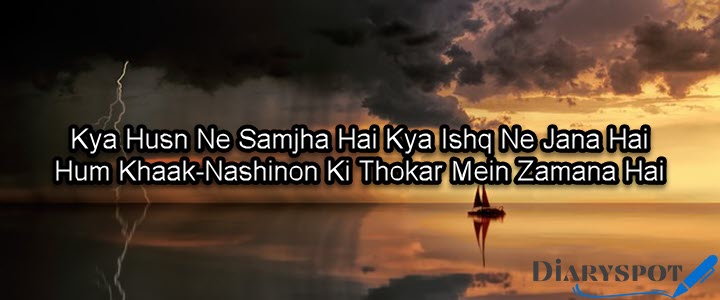
The poet’s appreciation of beauty in Persian and Urdu ghazals frequently reflects a soul’s desire for divine connection, giving the lyrics a depth of Sufi mysticism. The poet is the seeker, ever aiming for an unachievable divine beauty, while the beloved becomes a metaphor for God or the ultimate truth.
kuchh kuchh miri ankhon ka tasarruf bhi hai shamil
itna to hasin tu mire gulfam nahin hai
Zindagi ke hasin tarkash men
Kitne be-rahm tiir hote hain
2 line Tareef Shayari in Urdu
Furthermore, husn poetry occupies a special position in the cultural environment, where it is important for the expression and preservation of artistic ideals. Poets such as Mirza Ghalib, Amir Khusrau, and Allama Iqbal have perfected the craft of husn poetry over the ages to express universally relatable feelings.
Expressions of beauty continue to play a significant role in South Asian romantic literature, ghazals, and contemporary Urdu and Hindi songs, all of which carry on the tradition of husn poetry.
Har dil-fareb chiiz nazar ka ghubar hai
Ankhen hasin hon to khizin bhi bahar hai
Had se badh kar hasin lagte ho
jhuTi qasmen zarur khaya karo
Husn Ke Samjhne Ko Umar Chahiye Janan
Do Ghari Ki Chahat Mai Larkiyan Nahi Khultin
Husn poetry, as an art form, combines aspects of romance, mysticism, and intellectual contemplation to move the heart as well as the intellect. Husn poetry is an everlasting expression of beauty because it bridges the gap between temporal beauty and eternal aspirations.
Although husn poetry has changed in the modern day, its fundamental ideas have not changed. Though their fresh viewpoints take into account the intricacies of contemporary relationships and the reality of unrequited love or transient connections, poets and authors of today nonetheless praise beauty.
Falak Pay Chand Kay Haaly Bhe Sogh Krty Hen
Jo Tou Nahi Tu Ujaly Bhe Sogh Krty Hen
Humein Shayar Samajh Ke Yoon Najar Andaz Mat Kariye
Najar Hum Fer Le Toh Husn Ka Bazar Gir Jayega
aina dekh apna sa munh le ke rah gaya
sahab ko dil na dene pe kitna guroor tha
MuskurahaT hai husn ka zevar
Muskurana na bhuul jaay karo
Translations and adaptations now bring husn poetry to a wider audience, crossing linguistic and cultural barriers. It reminds us that admiration for beauty, in all its forms, is a sentiment that transcends both location and time. Husn poetry evokes equal admiration and longing, transporting readers to a realm where they cherish beauty but can never fully attain it.


Add comment